
Believe it or not, the price written on the agreement of sale is not the final purchase number. As you get closer to settlement, the title company will issue a settlement sheet outlining all the fees from your lender, the title company, the city & state, and your real estate agent. It’s best to shop around for fees when choosing a lender and a title company. Be cautious especially when shopping for a lender; if you find a one with a great rate, they may charge you expensive fees up front or vice versa. Seeing the fees charged at closing for the first time can be confusing. That’s why we provided a sample Estimated Closing Costs sheet so you know what to expect. We used a $400,000 home located in Center City of Philadelphia being purchased using a 30 year conventional loan with 4% interest and a 5% down payment.
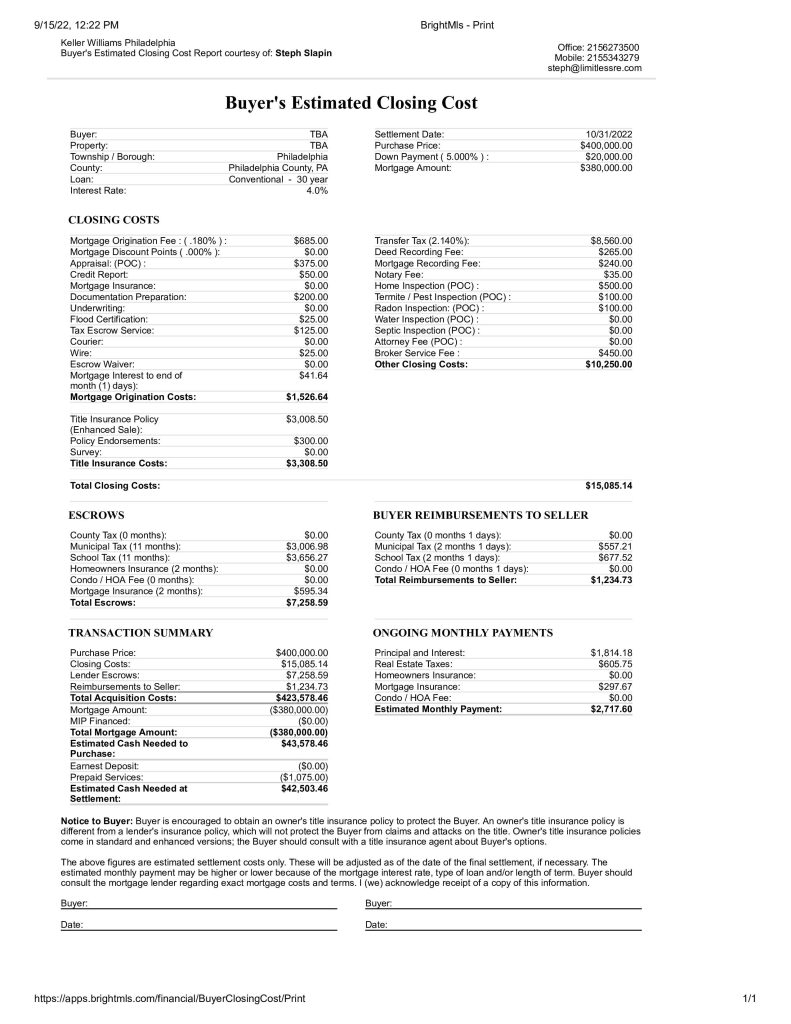
Types of fees:
Lender fees – every lender has fees associated with the work they do to finance the purchase of the home. Here are some fees lenders typically charge:
- Mortgage Origination Fee: a fee for the lender to initiate and process the paperwork.
- Appraisal Fee: this pays for the appraisal done on the home during the transaction. An appraisal is a property valuation to assess if the contract sales price of the home is warranted. If an appraisal value of a home comes in lower, the lender will only loan for the assessed amount and not the amount you (as the buyer) offered to pay for the home.
- Flood Certification: a document issued stating the flood zone status of a property.
- Tax Escrow Service: in your monthly mortgage payment, you pay a portion of your taxes. This tax escrow service takes that money on behalf of the lender and pays it.
- Homeowners Insurance: we left this one off the sheet because it does vary. Lenders require homeowners insurance to protect their investment. You can either request a quote for insurance and send it to the lender & title company for you to pay at closing or you can contact the insurance company and pay up front. Not sure what homeowners insurance is? Read our article!
- Mortgage Recording fee: the mortgage is recorded (submitted to official record) as a lien on the property.
Title fees – every title company has fees associated with processing title insurance for the property and solidifying the property transfer legally through all platforms of city, state, and federal government. Here are some of the fees title companies typically charge:
- Deed Preparation/Document Preparation
- Title Insurance Policy: don’t know what title insurance is or why you need it? Read our article!
- Notary fee: most of the closing documents need to be signed in front of a notary.
- Overnight/Courier fees: If documents need to arrive immediately, the buyer and seller can be charged.
- Wire fees: banks often charge additional fees to send wire transfers, so the title company collects that up front as to not pay out of their own pocket.
Government Recording & Transfer Charges
- Transfer Tax: In Philadelphia, the transfer tax is around 2% and is typically split between the buyer and seller (unless specified otherwise in the contract). The city and state transfer taxes can show up on the settlement sheet lumped together or broken down separately.
- Deed Recording Fee: the purchase contract is not recorded (submitted to official record) but the property deed is.
Miscellaneous fees
- Inspection fees: Your home, radon, termite and any other elected inspections are paid for up front and directly to the inspection company. It is not part of your closing costs, but is a payment you have to make up front early into the transaction.
- Property taxes paid by the seller: you will need to reimburse the seller for any taxes they have already paid for the remainder of the year from the time the property was transferred to the new owner.
- Condo/Co-op/HOA fees: if purchasing a condo/coop/HOA, you will not only need to pay whatever fees the association require up front (move-in fee, capital contribution, first month’s payment, etc.), you will also need to reimburse the seller for any payments they made from the time the property was transferred to the new owner.
- Broker Service fee: the commission of both the buyer agent and listing agent are paid by the seller, however, most real estate agents charge a flat fee to their clients and that can range depending on the agent.
Remember to check the fees when shopping around, especially when shopping for a lender! Being knowledgeable about the associated costs with purchasing a home can insure you are well prepared for closing. If we didn’t define something on the sheet or if you want to know more about a specific charge, you know where to call us!
Stephanie Slapin
September 15, 2022